
Creating an attractive outdoor space around homes that are built on a hill or incline can feel overwhelming and difficult to conceptualize. Utilizing property effectively on sloped yards can be challenging, and has many different considerations to factor in than yards that are flat. Some of those challenges include soil movement, water runoff, difficulty with plant establishment, and access for maintenance.
Thoughtful planning and practical solutions can turn challenging slopes into attractive, usable landscapes that complement the natural grade.
Designing a Sloped Yard Takes Extra Planning
Sloped yard landscaping ideas are different from those for flat ground, as gravity and water flow have a great impact on design decisions. Rainwater travels faster downhill, which increases the risk of soil washing away, leading to weakened plants, hardscape support, and even the foundations of structures.
Understanding the landscape’s conditions should be the first step in any sloped landscape project. This includes analyzing slope angle, soil type, drainage patterns, sun exposure, and access points. By taking these items into consideration, we can thoughtfully design a space that can be enjoyed for many years.
Good steep slope landscaping isn’t just about looks; it helps hold the soil in place, reduces runoff, makes the area more usable, and keeps people safe.
Terracing Hillside Property
Terracing involves dividing a steep incline into a series of flat, step-like levels. Each level/terrace becomes a manageable space for plants, seating areas, patios, or pathways. Terracing can turn unusable inclines into an attractive and functional outdoor space.
How Does Terracing Work?
Terracing turns one continuous slope into a space that appears like giant steps. These “steps” are a great place for garden beds, turf, or hardscape features. Each level is retained with a wall structure. This creates a horizontal surface that slows water and reduces erosion.
Terraces greatly improve drainage and make a yard safer and easier to maintain. They also give clear, defined areas that can each have their own function. For example, families may choose to have vegetable beds on one level, and a play area or patio on another.
Design Tips for Terracing
- For stability, align terraces to follow the natural contour lines of the slope.
- Ensure that terrace heights are easy to move between. This is especially important if you’ll add steps or paths between the levels.
- Integrate planting on terrace fronts to soften hard edges. This also helps with erosion control.
- Ensure that each terrace has enough drainage outlets so that water does not build up behind retaining structures.
Retaining Walls for Sloped Yards
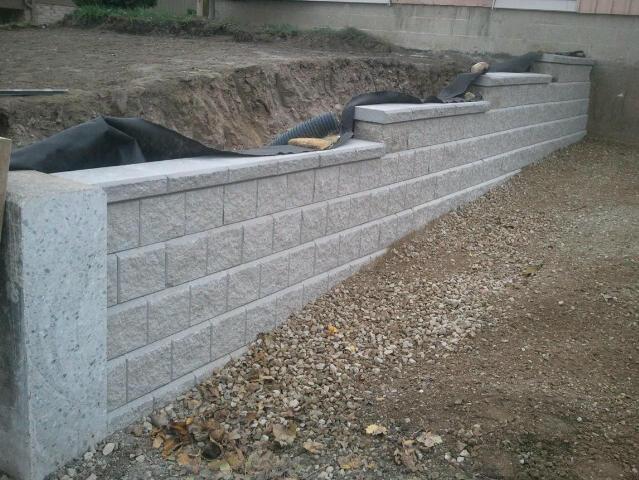
In sloped landscapes, retaining walls serve both functional and visual purposes. They help manage elevation changes, keep soil in place, and improve the look of the space. In Ontario and other regions with seasonal freeze-thaw conditions, these walls need solid design and construction that will handle the soil pressure and temperature shifts. Proper retaining wall design in Ontario helps prevent soil shifting, cracking, and drainage failures that can be caused by seasonal changes.
Retaining walls can be both functional and visually appealing. Some people choose to incorporate seating, built-in planters, and lighting into their design.
Erosion Control Solutions
Controlling soil erosion is especially important for steep slope landscaping. This is because heavy rainfall can wash away the soil as well as its plants and nutrients.
Plants are one of the best defenses against erosion. The roots of groundcover plants and shrubs work to bind soil particles together. This slows the water flow and protects the ground. When designing your plantings on sloped yards, drought-tolerant plants will do best near the top, while moisture-loving varieties will thrive on the bottom. This mix of plant types will help to slow water runoff and create a garden that is resilient.
Perennials and groundcovers such as sedum, creeping thyme, and fibrous grasses have deep root systems that help anchor the soil while also adding beauty to the space. In addition, mulching around these plants helps to further reduce runoff while also retaining moisture.
Plan, Build, and Maintain
Transforming a sloped yard into a lush and functional outdoor space requires thoughtful planning and skilled execution. Sloped yards can be unforgiving when mistakes are made, yet incredibly rewarding when designed well.
Landscape design for a sloped property is entirely different from that of a flat property. Mountview Services Inc. can help with that. We will start with a thorough site assessment before designing a plan that will give your hillside yard functionality, charm, and longevity.